
The City of Greater Dandenong (CGD) is developing its first Integrated Children, Youth and Family Strategy to guide future planning, delivery, and coordination of Council’s services for children, young people and their families.
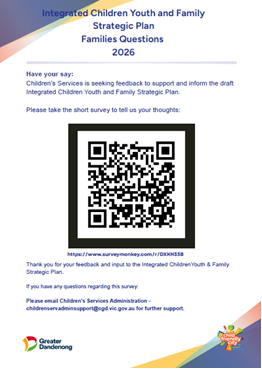
The City of Greater Dandenong is a key provider of services for children and young people (aged 0 –25 years), as well as their families across the municipality. Council plays a key role in the planning and coordination of services in the community sector. This includes facilitating capacity building and information sharing between services; identifying service gaps; advocacy to state and federal governments; and mobilising key stakeholders to respond to emerging issues for children, young people, and their families. As a key contributor to the work and services provided to children, young people, and their families, as well as community, we would like to invite you to share this survey via QR Code with your families, parents and carers.
Public transport is now free for children under 18. Children under 5 are already free and now Transport Victoria has introduced a Youth Myki card.
It costs just $5 to obtain the card and then no need to pay anything after this.
You can get your card at staffed train stations or by registering online Manage Myki
The Centre’s summary of the Report on Government Services 2025 is now available for download. The report covers:
- Child Protection
- Youth Justice
- Services for people with disability
- Housing and homelessness
- Health
- Early childhood education and care
Ensuring the wellbeing and safety of children is paramount. Yet, filicide, the killing of one’s own child, is the second most common type of domestic homicide in Australia after intimate partner homicide. Despite overall domestic homicide rates decreasing, filicide remains consistent.
This landmark report from ANROWS and the Australian Domestic and Family Violence Death Review Network presents the first national figures for filicides that have occurred in Australia in the context of domestic and family violence (DFV).
A significant 76 per cent of filicides in Australia occur within the context of DFV, involving a history of child abuse, intimate partner violence (IPV), or both. These cases are referred to as “DFV-context filicides”. This finding highlights the importance of safeguarding children through better understanding the impact of violence and resourcing effective interventions.